Turning Points was a five issue limited series published in early 2001, detailing the ups and downs of the relationship between Batman and Commissioner Gordon, across the whole of the characters' histories in the Post-Crisis DC Universe. Part 1 is set shortly after the "Year One" story arc by Frank Miller.
"Turning Points, Chapter One:
Uneasy Allies"
Writer: Greg Rucka
Artist: Steve Lieber
Colours: Tom McGraw
Letters: Willie Schubert
Synopsis: Now-Captain James Gordon returns home late, having missed another session with his marriage counsellor. He enters his apartment to find it empty, save for divorce papers left by his wife, Barbara, who says she has taken their son James with her back to Chicago. Gordon isn't given too long to feel sorry for himself, as he's called in to solve a hostage crisis at a Gotham cathedral. A man named Dr. Hale Corbett of Gotham University has taken a wedding hostage, and is wielding deadly force. Hiding in the bushes is Batman, who has yet to take action because he seeks Gordon's approval and trust. Gordon ascertains that Corbett lost his wife and daughter in a car crash that morning, and is now lashing out at the world. Gordon tries to reason with Corbett based on their shared feelings of loss, but isn't getting through. He covertly meets with Batman and gives him permission to take action. Batman breaks into the cathedral, spooking Corbett who nearly becomes dangerous before Batman subdues him.
Gordon goes home, tired and depressed, to find the Batman waiting there for him. Batman offers his sympathy for Gordon's recent loss, but Gordon grows angry and rejects the Batman's sympathy, stating they are not friends and accusing the Batman of knowing nothing about loss. The Batman counters that he knows more than Gordon thinks, and that "everyone needs a friend", before leaving.
My Thoughts: This story is mainly meant as a pastiche of "Year One" and on that level works fairly well, though it comes nowhere near the level of excellence of that seminal story-arc. The parallels between Gordon, Corbett, and Batman are well handled, and the story's emotional content is far stronger than it's rather pedestrian plot -- but then I think that's the point. The connection between Batman and Gordon goes beyond the uneasy alliance forged by circumstance in "Year One" and towards a more amicable relationship and bond.
The Art: Steve Liber is intentionally working in the style of David Mazzuchelli here, and occasionally it works. His Gordon is dead-on right, and his Batman is often very good, though sometimes doesn't look quite right. Lieber shows considerable talent and skill as an inker, but his actual line-work isn't a hundred percent up to par. He still does a very good job of evoking the world and characters created by Mazzuchelli in "Year One" -- aside from Gordon and Batman there are also appearances by Merkel and Branden. Unfortunately, Lieber's valiant efforts are somewhat undone by colourist Tom McGraw. While McGraw's colouring choices would've been right in any other book, in the context of aping the "Year One" style, they appear flat, primary, and out of place beside the work of Richmond Lewis.
The Story: Greg Rucka's writing is probably the saving grace of this short tale. He has a strong command of the personalities of both the "Year One" Gordon and Batman, and does a good job of aping Frank Miller's style from that book. He continues Miller's dual narration from Gordon and Wayne, while letterer Willie Schubert copies Todd Klein's different journal/writing styles for the two characters. Rucka gives a good portrait of Gordon, especially, continuing the style of "Year One" wherein Gordon was a main character and Batman almost a supporting one. Rucka gives good references back to "Year One" as well as clever foreshadows to later series such as The Long Halloween.
Notes and Trivia: First time Gordon's wife Barbara leaves him.
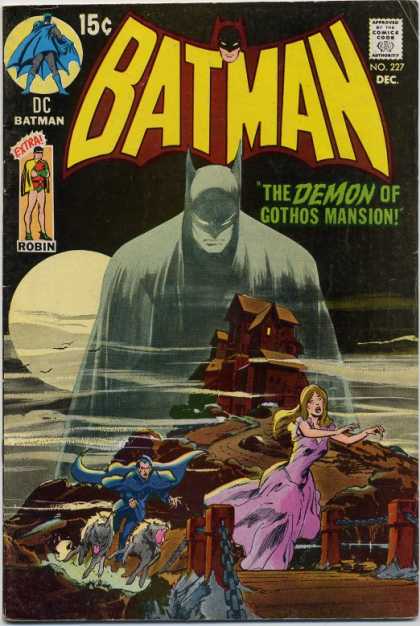
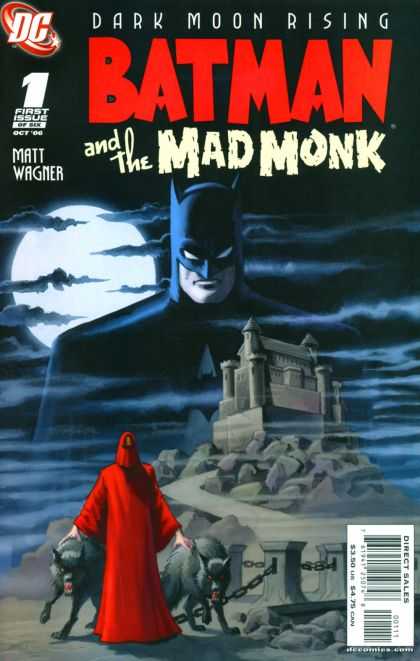
 Okay, I have to open by saying this is a bloody magnificent cover. The combination of moody etherealness and iconic imagery makes it memorable and dynamic, and has led to it being copied at least twice. Inside this cover, we'll find the first part of DC's very first multi-part story - a story which resonates so well that it has been retold in both the Bronze and Modern Ages. The story of...
"Batman Versus The Vampire, Part One"
Writer: Gardner Fox
Pencils: Bob Kane
Inks: Sheldon Moldoff
Synopsis: The story begins with moody, iconic imagery of the Batman patrolling the rooftops of New York (not yet Gotham) City. He spots a young woman about to attack an older man, apparently under the orders of "the Master Monk." The Batman saves the man, and discovers the young woman to be none other than Bruce Wayne's fiancée, Julie Madison. He takes her back to her apartment, and the next day Bruce takes her to a doctor. The doctor believes Julie was hypnotized, and recommends an ocean voyage to Paris as treatment (???) and later to Hungary, land of "history and werewolves!" The doc has an odd look on his face, as if he too is hypnotized - the reader can almost imagine his shifty eyes. Bruce buys Julie the ticket, but then decides to follow her as the Batman. For this purpose he has two new inventions, the Bat-gyro (a plane with the rotors of a helicopter, look it up kids), and the Baterang, which is described as being specifically designed after the Boomerang. The Batman then follows Julie's ocean liner in the Bat-gyro over the Atlantic. He leaves the Bat-gyro hovering above the ship, climbs down a rope ladder to speak to Julie, and they get attacked by a mysterious figure in a red rope with a somewhat KKK-looking hood -- it's the mysterious Monk! His hypnotic glare seems to paralyse the Batman, but he manages to throw a baterang at him, which breaks his concentration. The Batman then jumps onto the rope ladder and back into the Batgyro. Which... I suppose leaves Julie helpless to the Monk, who is still down there???
Ignoring that, the Batman soon reaches Paris, where he then searches all over town looking for clues to Julie's whereabouts, which I assume is a lot easier than just following her? And presumably much, much easier than if he'd just come with her on this trip as Bruce Wayne?? Nevertheless, he tracks her to her hotel room and jumps in through the window whereupon a GIANT GORILLA IS WAITING TO KILL HIM! Batman sidesteps the gorilla, but in doing so he somehow manages to fall down a trap door and into a giant net!
He is now suddenly in the lair of the Monk, who taunts the Batman and flips a lever to lower him into a pit of snakes. But the Batman throws his baterang, which smashs an overhead chandelier, and the Batman uses the shattered glass to cut through the ropes and out of the death trap. He runs after the monk, but is again trapped in a giant cage which also holds the GIANT GORILLA! However, Batman manages to escape by climbing up the rope that lowered the gorilla into the cage, and he proceeds to escape the building and get back into the Bat-gyro.
He then pursues a car speeding away from the building, throws gas pellets at it, and then after it crashes into a tree, recovers Julie from it and gets back into the Bat-gyro. He then sets a course for Hungary, land of werewolves and vampires. Part two next month!
My Thoughts: This is one of the all-time classic Batman stories. The first time I read it was in the first edition of The Greatest Batman Stories Ever Told TPB. Yet, it really shouldn't be. It continues Gardner Fox's habit of gaping plotholes and leaps of logic, and really doesn't hold up well as a tale by itself. But there is just so much excitement and iconic action and suspense and mystery and macbre, weird details that the whole thing seems far more fantastic and exciting then a Batman comic has ever been. The fact that the tale ends with the Monk still out there, and Batman continuing to track him was a unique and unheard-of ending in comics at the time, and has the reader waiting with baited breath for next month's issue.
The Art: The art is what really sells this story. While the actual plot borders somewhat on nonsensical, Kane and Moldoff create moody, dynamic, exciting action and suspense images. The Batman looks great in these panels, with a long, swooping cape, long ears, and now longer, extended gloves. The visual design of the Monk is unique -- instead of the stereotypical Dracula look, he wears a red cloak and hood, and upon the hood a yellow skull and crossbones on the forehead. All in all it is Kane's artwork here and in part two that contributes to this story being well-remembered, and shows a definite move forward in the quality and style of the art for the Batman feature.
The Story: While Gardner Fox does deliver on his promise to introduce a foe worthy of Batman's mettle, and gives us the first truly fantastic Batman tale, his actual plotwork is shoddy at best. If Julie was being hypnotized into attacking people, why didn't the police get involved? If the doctor was obviously shifty, why take his advice to travel to Paris? What kind of prescription is that anyway? Why did the Batman not take the Monk down when he (somehow) appeared on Julie's ocean liner, instead of leaving him there to commit further evil? Luckily, Bob Kane's artwork sweeps us along the story so well that we don't really ask these questions while we're reading, happy as we are to just keep going with the story. An interesting note is how the character of Julie Madison is introduced into the strip with no introduction or development -- she's just suddenly Bruce Wayne's before-now unseen fiancee and is already the damsel in distress focus for the plot. That's the Golden Age for you. Julie will be the first of many attempts to introduce a regular love interest character into the Batman stories.
Notes and Trivia: First appearance of Julie Madison, first appearance of the "baterang" and "Bat-gyro", first appearance of the Mad Monk, first death-trap and death-trap escape, first multi-part story in comics, first unresolved ending,
 "He's out to clean up a city that likes being dirty.
He can't do it alone."
"Batman: Year One, Chapter Four:
Friend in Need"
Writer: Frank Miller
Artist: David Mazzucelli
Colours: Richmond Lewis
Letters: Todd Klein
Synopsis: This issue begins with Gordon realizing he has to end his relationship with Essen. It's the only thing to do, he thinks. Meanwhile, he also arrests Jefferson Skeevers, a drug dealer who was the connection between Flass and the police force and organized crime in Gotham. However, Harvey Dent lets Skeevers get released on bail, for reasons he does not explain. Turns out Harvey's made a deal with Batman, who shows up at Skeevers' apartment and scares the living daylights out of him. The next day he shows up in Gordon's office willing to cop a plea and talk all about Flass. Gordon takes his statement without informing Loeb and hands Flass over to Internal Affairs. Loeb threatens Gordon with pictures of him and Essen.
Meanwhile, Gordon makes it over to Wayne Manor to question Bruce. Wayne appears to Gordon as a totally irresponsible, womanizing drinker. Gordon drives away, and then tells his wife all about his affair with Essen. Meanwhile, it turns out the champagne Bruce seemed to be drinking was club soda.
By October 2, Dent and Gordon are questioning Flass, Loeb's attempts to blackmail Gordon have failed, and even the mob's attempts to kill Skeevers aren't stopping him from testifying. Gordon's baby son is born on the 11th, meanwhile Loeb's memorabilia collection is stolen, with the theft blamed on Batman.
In actuality it was Selina Kyle, in her new guise as Catwoman. She is incensed that the media giving the credit to Batman, and even more angry that she sees no value in any of the pop culture collectibles she stole from Loeb. She decides to steal from the Roman, and scratch his face to leave a signature that it was not Batman who did it.
Later that evening the Batman is flying high above the Roman's penthouse apartment in a custom hanglider, listening in on the Roman's conversation with a bug he's planted. Turns out the Roman has brought in his nephew, Johnny Viti, to try and get Gordon out of the way. However, before Batman can learn the Roman's plan, Catwoman shows up and starts attacking the Roman and his guards. Batman almost instantly dispatches the guards and the Roman, leaving Catwoman alone and confused. She scratches the unconscious Roman's face anyway.
Bruce figures out how Falcone's going to get at Gordon, and leaves to stop him. He does not go out as Batman, however, as it is daylight and he feels the costume would lose all effect.
The media claims the Batman attacked Falcone and lists Catwoman as his assistant.
Loeb calls Gordon out on a minor errand, and almost too late does Gordon realize it's to give them time to kidnap his wife and son. Wayne shows up on a motorcyle and saves Barbara, but Johnny Viti drives off with Gordon's son. Gordon and Wayne pursue and Gordon shoots out Johnny's tires. Gordon and Johnny fight at the edge of a bridge, and the mobster drops Gordon's son into the river.
However, Wayne has dived in after the child and saves him. He hands the child over to Gordon, who has lost his glasses in the scuffle and claims he cannot see anything without him, giving a plausible denial to recognizing Wayne.
The issue wraps up quickly detailing how Flass testifies against Loeb, the mayor outs Loeb as commissioner and puts in a man called Grogan, the Roman ends up at war with his sister because he tried to have Johnny killed, and Gordon is promoted to Captain. The issue ends on December 3, with Gordon standing on a rooftop, remarking that someone called the Joker has threatened to poison the Gotham City reservoir -- but that Gordon has a friend who is coming to help. ;)
My Thoughts: While the ending is perfect, there's something about this issue that doesn't work for me. Maybe it's because Miller wraps up way to many plotlines way too quickly. He sprints to the finish line and at the end of the day nothing is really satisfyingly tied up. What happens to Selina? Of course, the Year One series is meant as the beginning of a story, so it makes sense not to tie everything up, though disappointingly the threads left dangling by this story really wouldn't be picked up until The Long Halloween series in 1996, although the Catwoman arc would be continued as early as her own series in 1989. However, the final image of Gordon on the rooftop, awaiting Batman's help to deal with the unseen threat of the Joker is a great moment.
The Art: Mazzuchelli continues to be brilliant, although his work here is less spectacular than last month and much more pedestrian. I'm still impressed to get the maximum amount of expression out of his characters with a seemingly minimal amount of linework. He always keeps the imagery within the real of realism too, nothing ever appears cartoonish or melodramatic. However, something about the rescue scene at the end of the issue never really worked for me. It seems almost as if he chose the wrong images in the sequence for his panels. It feels choppy. I guess it's supposed to imitate slow motion or something.
The Story: As I said above, this final issue feels rushed and incomplete. But even that is a compliment to Miller's amazing economy of storytelling -- an economy that's even more incredible given that it took Miller two and a half years to tell maybe three issues worth of story in his All-Star Batman & Robin series. Good stuff. The ending makes me wish we had maybe seen Miller get to continue to tell Batman stories in a Year Two vein. Y'know, back when he was a good writer.
Notes and Trivia: First appearance of Johnny Viti, Gordon is promoted to Captain.
 Oh God, my face! Why are you blowtorching my face??
*ahem* Pre-Code covers aside, this month we get the second Gardner Fox Batman story. Last month he teased us with the possibility that the despicable Dr. Death may be still alive! And why would he tease us if that wasn't the case? And why would he start off this month's story with a recap of last month's ending (Batman watching Dr. Death burn to, erm, death) if that wasn't the case? And if that wasn't the case, why would this month's title be...
"The Return of Doctor Death"
Writer: Gardner Fox
Pencils: Bob Kane
Inker: Sheldon Moldoff
Synopsis: After briefly recapping how "about a week ago", the Batman watched Dr. Death "burn to ashes", we look in on Bruce Wayne reading a newspaper item about a man who dies of a disease that turns him purple. Wayne concludes "Only Dr. Death could be at the bottom of this." Um, what? Excuse me, but I think you need to go back to detective school Wayne, if your first reaction to a news item about a man dying of illness is that it MUST be the work of a dead madman. "Yet, he is dead," continues Wayne. Wow, really brilliant. Okay, puzzle it out, Wayne... "It's strange, this hunch of mine that he is still alive." Bruce Wayne is like one of those crazy people who insist on very little evidence that Elvis is still alive. Except Elvis is a mad scientist. And Bruce is right.
So Bruce goes off to visit the dead man's widow, and is admitted by their maid. Mrs. Jones says that her husband was killed because he refused to pay half a million dollars to Dr. Death. She then goes on to say that they have no money and lost it all in the Depression. So... why did Dr. Death pick them to extort then? And how can she still afford that maid?? Turns out, however, the Joneses have some diamonds.It was apparently Mr. Jones' "hobby" to collect them! Expensive hobby during the Depression! "I must get them out," says Mrs. Jones absent-mindedly, "for I need some money." Wow. That only took you ten years, lady.
Bruce goes back to his mansion to change into the Batman (he gets the costume out of a chest in a living room), and then zooms off in his "specially built, high powered" red car to the Joneses, where he proceeds to break in and start stealing the diamonds from the wall safe. Okay, Batman... far be it from me to question your crime fighting techniques, but, what the fuck?
"Meanwhile, Doctor Death still lives!" announces Mr. Fox, as a heavily bandaged figure instructs a large Jabah-like man to go to the Joneses and steal the diamonds and bring them to a fence named Herd. Dr. Death explains he escaped the fire through a trap door in the floor. His new henchman is a large man in a fez who is referred to as Mikhail, which makes him Russian, I guess. Do Russians wear fezes?
Mikhail breaks into the house and the Batman hides and watches him take the diamonds from the already-opened safe. Mrs. Jones enters the room, prompting the Batman to tackle Mikhail and punch him out the window. The Batman then proceeds to give the unconscious Mikhail the diamonds, reasoning that the only way Mikhail will lead him to Dr. Death is with the diamonds (okay...). Batman follows Mikhail to Ivan Herd's pawn shop, and then follows him to an apartment building, reasoning that Dr. Death is living low after losing everything in the fire. Batman breaks in and discovers... it's actually just Mikhail's apartment. He searches the room for any clues to Dr. Deaths whereabouts and finds... nothing. Was the real Batman on holiday this week? Who's this incompetent boon, Jean-Paul Valley?
Anyways, Mikhail (whose been sleeping) wakes up and shoots Batman at point blank range and misses. Did everyone take stupid pills this morning? Batman dives out the window. Mikhail sticks his head out to shoot after him -- AND BATMAN SWINGS DOWN ON HIS ROPE AND KICKS HIM IN THE HEAD, SNAPPING HIS NECK. Yep, Jean-Paul Valley for sure.
The Batman calls the police and tells them that Mrs. Jones' diamonds are at Ivan Herd's pawn shop and to go there. Batman then drops in on Mr Herd and starts intimidating him about Dr. Death. Herd runs off, and Batman ropes him in, only to discover that beneath the old man mask, Herd is really... DR. DEATH!! Turns out the Doc's face was horribly disfigured in the fire, and now he looks like the Phantom of the Opera with green skin and a goatee. Batman leaves Dr. Death for the police along with a card saying to give the diamonds back to Mrs. Jones.
My Thoughts: This issue is just bad. Dr. Death made a pretty weak first impression last month, and this follow up is just awful. Two bad appearances in a row contribute to this character disappearing off the radar for a whole forty-three years, before being brought back by Gerry Conway. Batman is really out of character in this appearance, and the whole story just feels sloppy and unrewarding, especially since we don't even see Dr. Death until the second-last panel and there is no real battle or confrontation between our hero and his enemy.
The Art: Okay, a few notes on the art this issue. First off, THANK YOU Bob Kane for getting an inker! Sheldon Moldoff brings a much needed sense of shadow, depth, and dimension to Kane's pencils, giving us a moodier feature more closely in line with the visual look of the pulp inspirations to Kane's creation. Another note is that the look of the Batman begins to change, as the ears on his cowl have become much taller and thinner here, and the cape is much longer and voluminous. This long-eared look will last for another five months, and be the longest the ears will ever be until Neal Adams comes on in 1969.
The Story: Okay, Gardner Fox isn't even trying with this one. The story is full of holes and coincedences and flat-out nonsensical sections even for a ten page feature in a Golden Age comic meant for children. Nothing makes much sense, from Batman's lack of detective skill, to the diamonds, to the fact that Dr. Death orders his henchmen to bring the jewels to a fence who IS Dr. Death! The whole thing feels completely slapped together and second-rate.
Notes and Trivia: Final Golden Age appearance of Dr. Death.
Batman Body Count: 4
 Last time we saw Batman, he was being carpet bombed by helicopters while trapped in a tenement building while SWAT teams close in. We rejoin the story currently in progress.
"Batman: Year One, Chapter Three:
Black Dawn"
Writer: Frank Miller
Artist: David Mazzuchelli
Colours: Richmond Lewis
Letters: Todd Klein
Synopsis: As the bombing continues, Batman loses his utility belt and must hide in the basement. Meanwhile, the noise and light show awake Selina Kyle and her young roommate Holly Robinson. Their apartment is full of cats.
At the scene, Branden goes in with a SWAT team while Gordon begins to have a crisis of conscience regarding the Batman and the GCPD. The SWAT team searches for Batman, who Vulcan neck pinches two of them and steals a radio, mocking Branden. Selina and Holly arrive with a growing crowd of people around the scene. Hiding from the SWAT, Batman activates a device in his boot which summons the bats from the cave under Wayne Manor, and dispatches a cop with a blowdart poison. It draws attention to his position and the SWAT opens fire. In the confusion Batman rescues a cat from the gunfire, which ends up in the arms of Selina Kyle. Batman kicks down the last ceiling support and brings the building down around them. He also makes a point of throwing the cop who shot at the cat through a brick wall. Gordon notices that the crowd has begun cheering for the Batman, instead of the cops -- but the cheering turns to screams as a cloud of bats flies into the area, creating enough confusion for Batman to escape by motorcycle. In the aftermath the whole crowd is vaccinated for bat bites, most of Branden's team is hospitalized, and the owner of a nearby men's shop finds a three-piece suit missing, but the payment for it in hhis cash register.
Still pursuing Bruce Wayne as his primary suspect, Gordon discovers he's been skiing in Switzerland the past six weels and broken both legs and one arm. Essen points out that's identical to the spots Batman was shot in. Meanwhile, Bruce realizes he can't keep doing this if the entire city is against him, and decides he needs Jim Gordon on his side.
In the East End, Selina punches out Stan the pimp and announces to Holly that they're finding new work.
Gordon and Essen begin drinking coffee after work. He learns her name is Sarah and her background. They get caught in the rain, and begin an affair. Selina spends all her money on a Cat costume and, over the protestations of Holly, leaps out the window to become the Catwoman. Gordon, meanwhile, sinks into depression when he realizes that his marriage is falling apart, he's in love with Sarah Essen, and that the Batman may be the only hero in Gotham.
My Thoughts: Part Three mostly centers around a dynamic action sequence featuring the Batman cornered by Branden's SWAT team. This scene would influence similar occurances in the animated film Batman: Mask of the Phantasm and 2005's Batman Begins. The Miller/Mazzuchelli team really cements their position here as premiere Batman storytellers, and the quiet, introspective ending is the perfect capper after the action packed opening. I also have always liked the scene where Selina punches out her pimp. A very strong character moment. A good issue, all in all.
The Art: David Mazzuchelli continues his spectacular artwork this issue, creating iconic and moving imagery. A panel where a cat leaps into Selina Kyle's open arms always strikes me with its simplicity and powerful sense of character. The panels depicting the cloud of bats swarming over the crowd are powerful, dramatic, and a little bit frightening. Mazzuchelli continues referencing classic noir sources, including the panel of Gordon and Essen at a coffee shop called "Hopper", which is a lift from the classic painting Nighthawks. The images of Gordon and Essen in the rain are classic noir, the panel of Selina leaping from her window is a defining Catwoman image, and the last page of a shadowed Gordon sitting on his bed, cradling his pistol is gripping and heart-wrenching.
The Story: Miller keeps the threads moving here as well as introducing a few new themes. Primary among this is the beginning of Wayne and Gordon realizing they need to be partners, not enemies. This reaches its head in part four, completing the fated interaction of these two characters begun in part one. Miller also moves Selina Kyle's story ahead, showing us that the actions of Batman are beginning to have an influencing affect on the population of Gotham. Miller uses a "less is more" technique with Selina, showing us only key moments and refusing to focus on her or fill in the dots. This keeps "Year One" a story about heroes and avoids the villain-centric trap most Batman storytellers fall into.
Notes and Trivia: First appearance of Post-Crisis Catwoman.
 Turning Points was a five issue limited series published in early 2001, detailing the ups and downs of the relationship between Batman and Commissioner Gordon, across the whole of the characters' histories in the Post-Crisis DC Universe. Part 1 is set shortly after the "Year One" story arc by Frank Miller.